About the project
A Student’s Perspective inside the DPPP
A Student's Perspective From Inside the DPPP
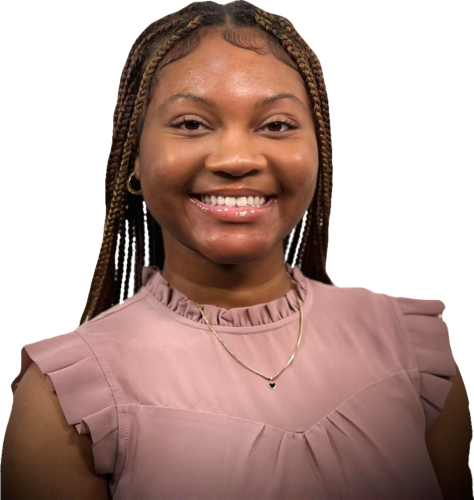
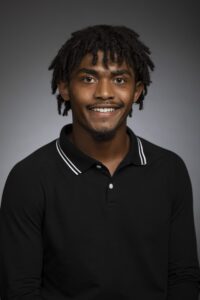
My name is D'Asia Johnson
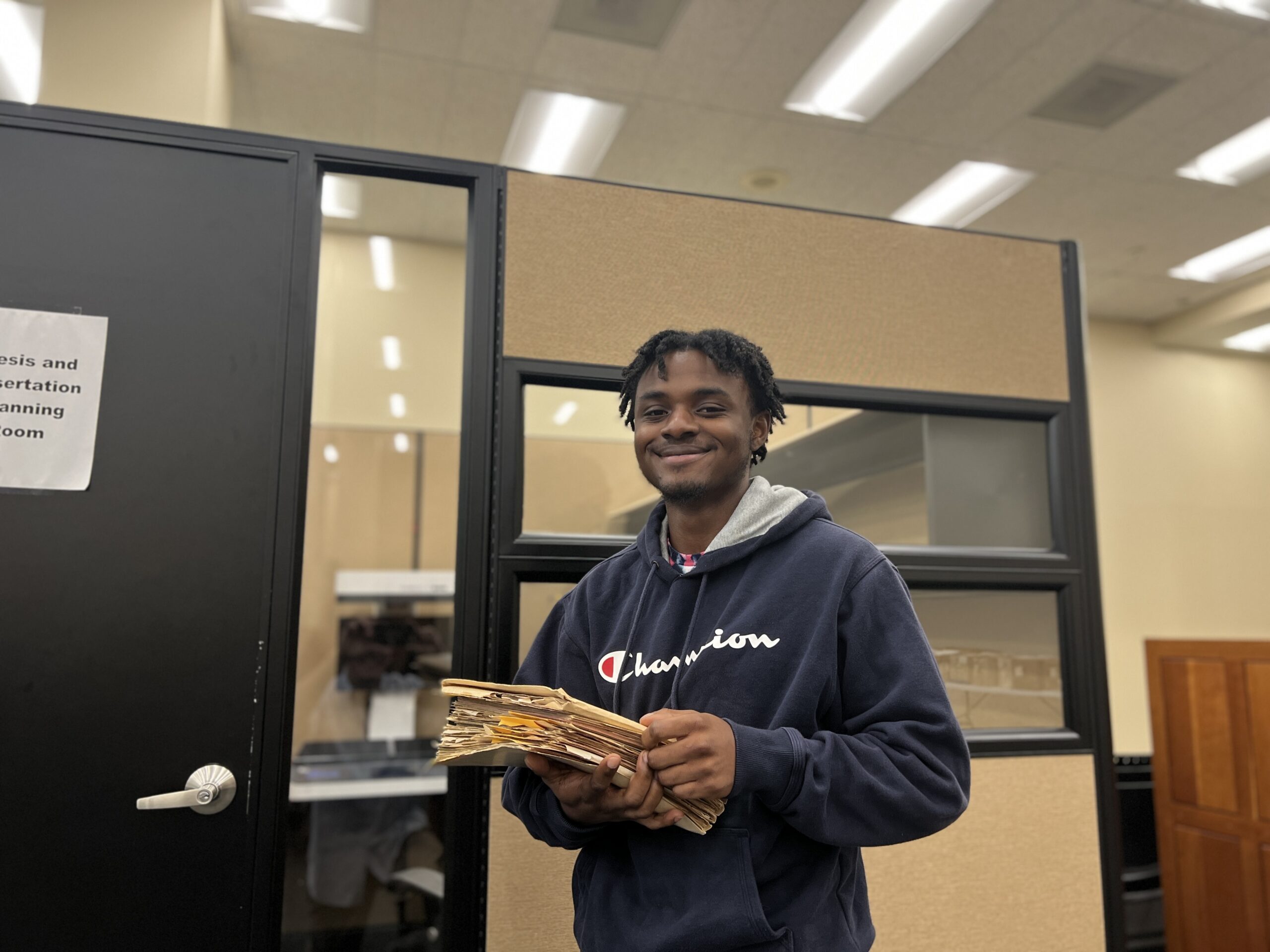
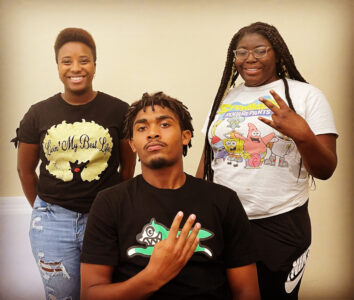
I have worked on the Digital PV Panther Project for about two months as an archival assistant, and I have embraced the role of historic preservationist at my HBCU. Whether curating social media posts, taking inventory of the archives, processing manuscript collections, or digitizing photographs, my goal is to encourage research in the rich historical collections in the archives at PVAMU.
I spent a lot of time taking inventory on the manuscript collections of former PVAMU professors and administrators who worked in the Cooperative Extension Service.
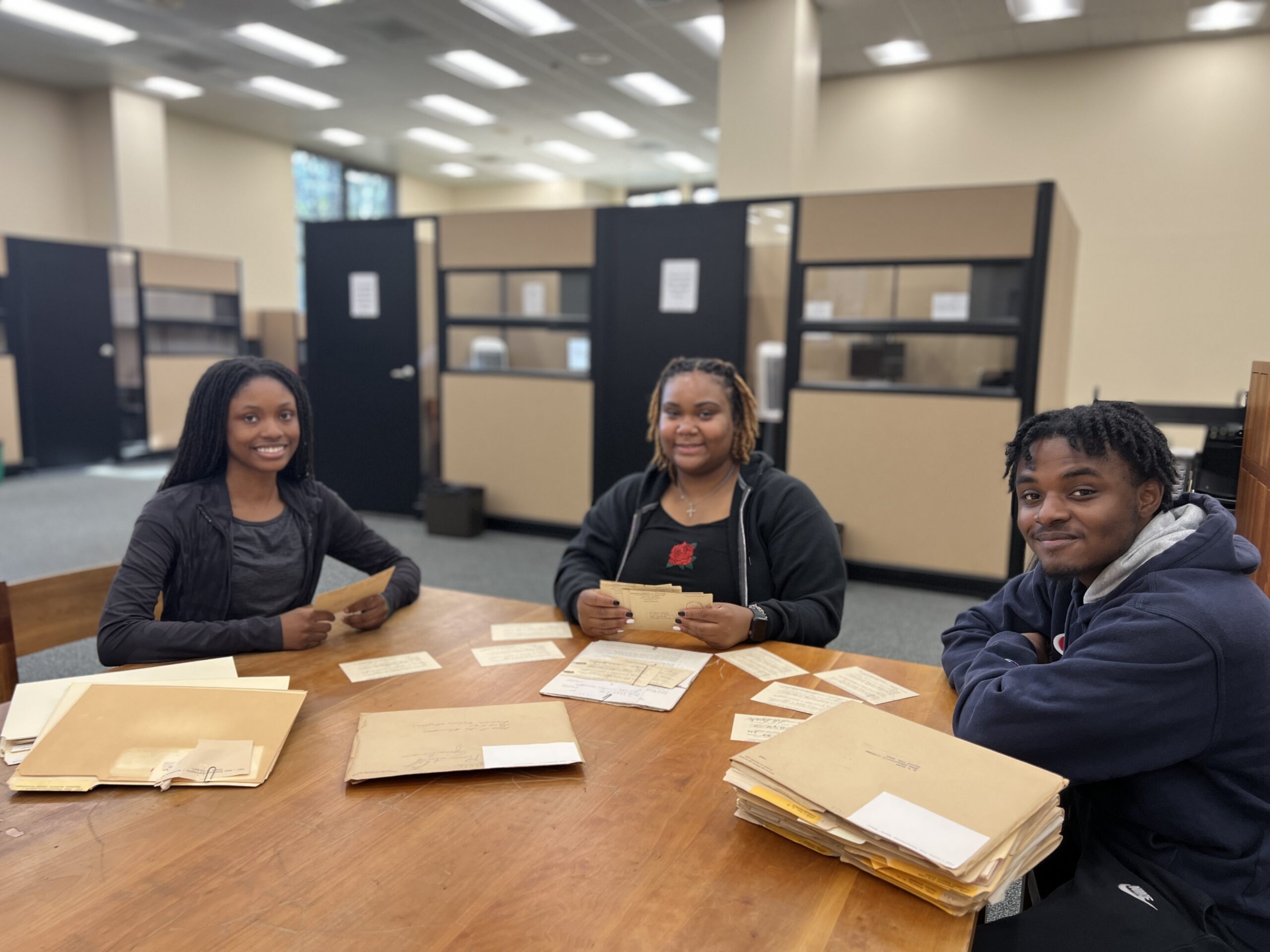
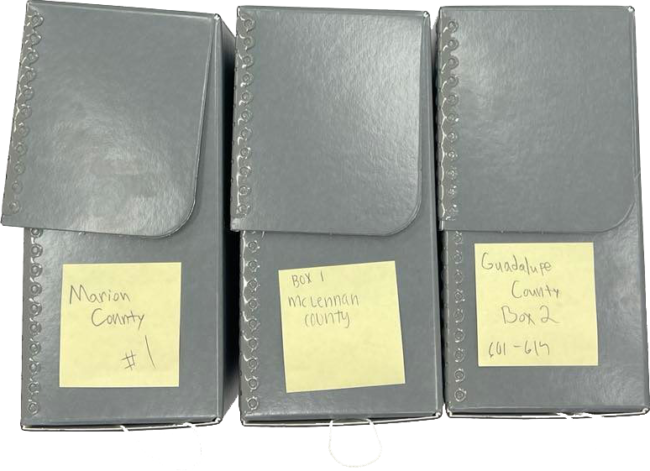
The inventory sheets for most of the Cooperative Extension & Home Demonstration Collection were outdated, having been completed originally by students in the early 2000s. Thus, I spent a lot of time revising inventory sheets in Microsoft Excel. In each instance, we checked the titles of each folder and made sure it was accounted for in each box. After making sure the folders were placed in the correct location and listed correctly, we went back through the boxes and noted the presence special media–maps, photographs, diagrams, etc. We made sure to check the accuracy of our work, because we had to have all the media in order prior to processing the collection.
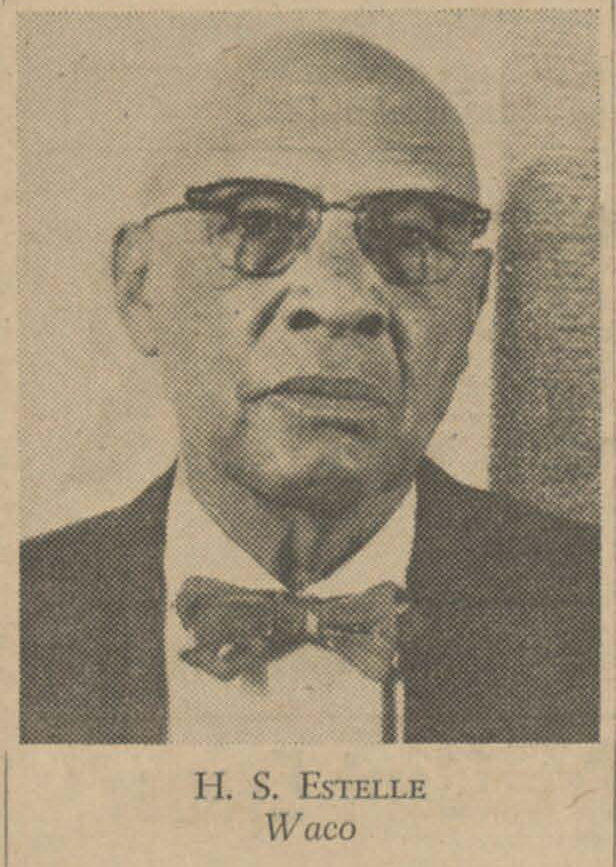
I also compiled lists of source material in the Digital Commons, and I wrote summaries of each source in preparation for writing biographies of former professors for finding aids.wrote a biography on one of the many professors that attended this school. While I did not have much experience writing memoirs, I was assigned to write one on a professor who made a remarkable impact on Prairie View A&M, specifically Professor Henry Seward Estelle. He had an incredible effect on the Agricultural department from the early to mid-1900s. In addition, he partook in much more positions and events that occurred at Prairie View. If you want more information on Prof. Estelle, you can find his biography here Henry Seward Estelle – The Digital PV Panther Project.
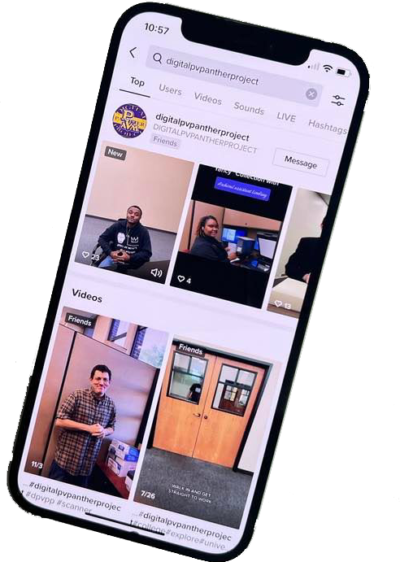
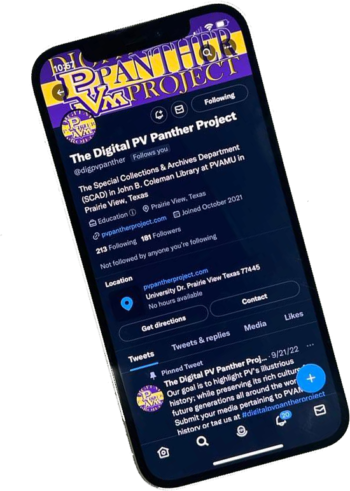
I also assist in maintaining our social media pages. Being a part of our social media team, I help my coworkers develop ideas for posts. You can find me on a few of our Instagram, Facebook, and TikTok posts. In addition, we have made many posts that depict the rich history of PVAMU using photographs, blog posts, blueprints, and maps.
@digitalpvpantherproject Massive! The manuscript collections in the PVAMU Archives are massive in their scope and breadth! The Cooperative Extension & Home Demonstration Collection contains more than 100 linear feet of photographs, maps, and documents that date back more than 100 years and cover over 45 counties in Texas! #dppp #digitalpvpantherproject #hbcu #pvamuhistory ##pvamu##hbcuhistory##digitalcommons##archives##media##campus##digital ♬ Mission Impossible Theme (Movie Trailer Mix) – Dominik Hauser
I have also contributed to meetings with out team leaders, Dr. Moore, Ms. Earles, Lindsay Boknight, and Noah Jackson. We discuss our progress, our strategies, our upcoming projects, and our plans for the future. Indeed, I am amazed at the way that Dr. Moore incorporates our ideas into the project. The Digital PV Panther Project does not have the usual sort of top-down administrative style. Rather, Dr. Moore relies heavily on the input from myself and the other archival assistants to light the way. Whether it’s the method of taking inventory or processing collections, Dr. Moore always listens to our ideas about the project, and he allows the team leaders to manage our workflow.
Thus far, my work on the Digital PV Panther Project has been eye-opening. To have the opportunity to work with such remarkable people and partake in such a significant project is astounding, to say the least. I hope to be able to continue to work on this project and share the incredible history of Prairie View with my peers, university staff and faculty, and with those across the nation. There are so many collections in the archives to discover and share with the public, and I am very appreciative of having the opportunity ro work on the Digital PV Panther Project.
The history of our HBCU should not be forgotten.
Digital Preservation at PVAMU
By Kasedi Eason
Identifying Texas Freedom Colonies
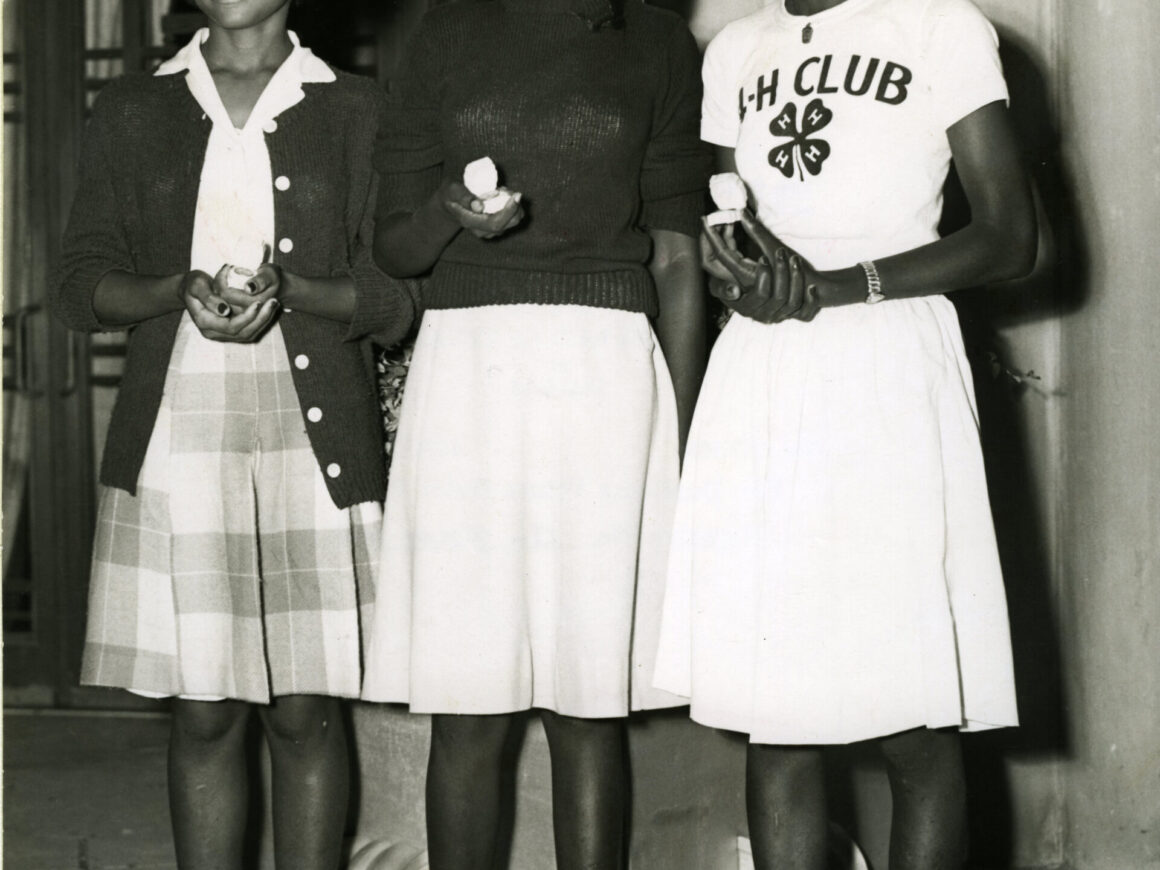
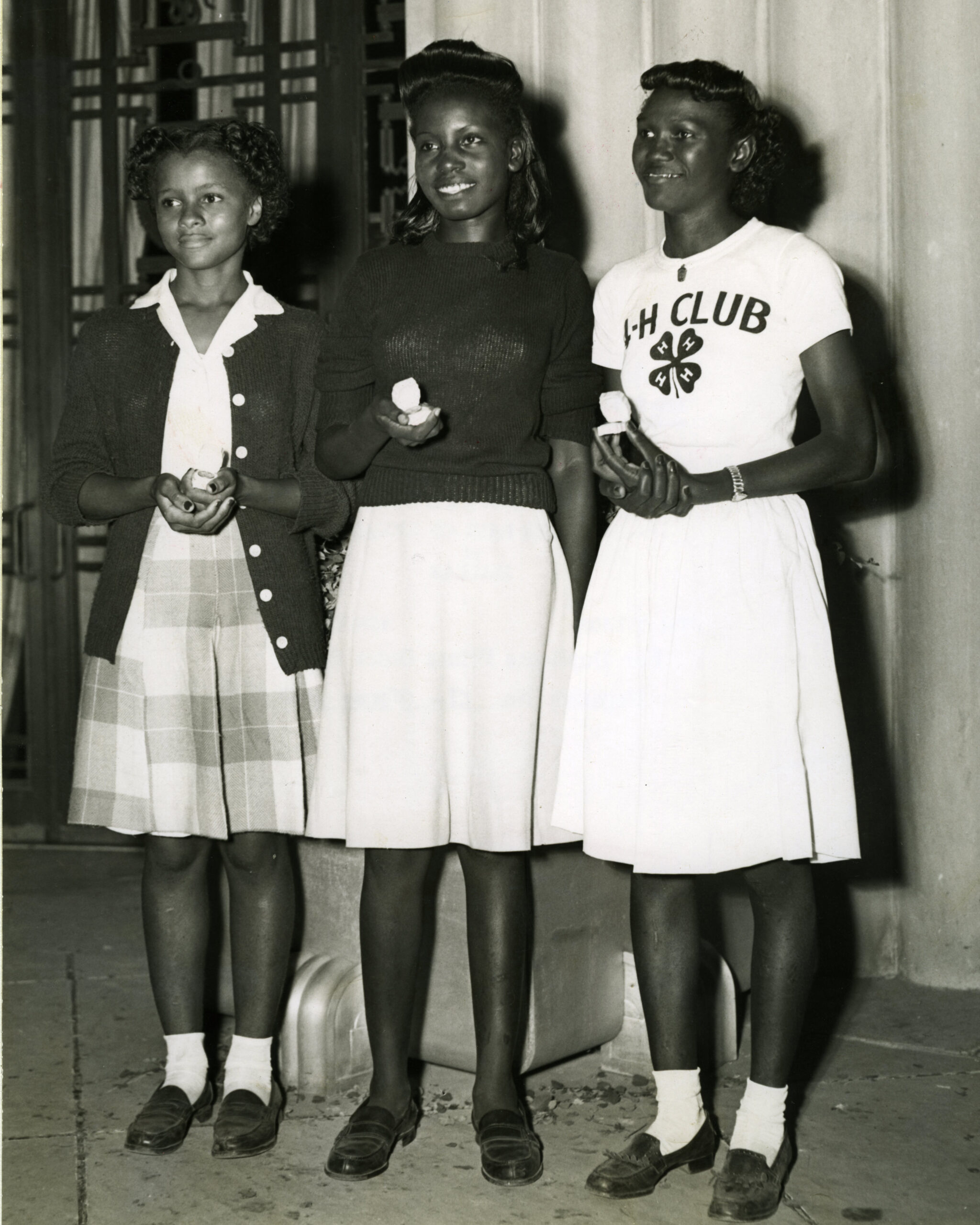
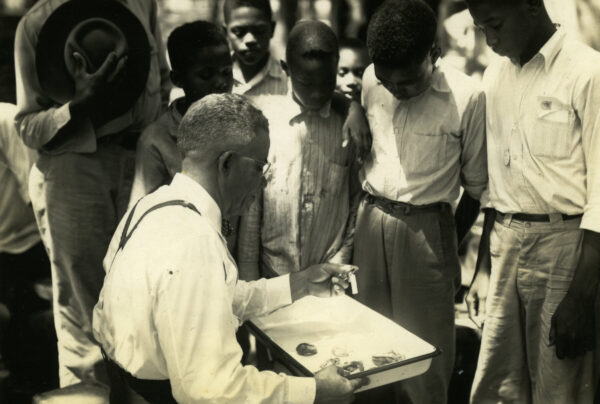
My name is Kasedi Eason, and I started working as an archival assistant on the Digital PV Panther Project in late August 2022. I document my work on the project daily, and it allows me to share with the public my experience in the archives. On August 31st, for example, I started to examine the archival media in the Cooperative Extension & Home Demonstration Collection, specifically he photographs taken by Cooperative Extension agents to demonstrate their work in the rural African American communities in Texas. The county agents worked very hard to improve the quality of life in rural communities through scientific farming and homemaking. Considering that so many of these communities no longer exist, and that the number of Black landowners significantly declined in the 1950s, this collection is especially significant because it documents the Black experience in Texas Freedom Colonies.
A future aspect of the Digital PV Panther Project will be adding data to the WebAtlas of the Texas Freedom Colonies Project–an educational and social justice initiative dedicated to supporting the preservation of Black settlement landscapes, heritage, and grassroots preservation practices through research.
1940s Map of Texas Freedom Colonies in Grimes County
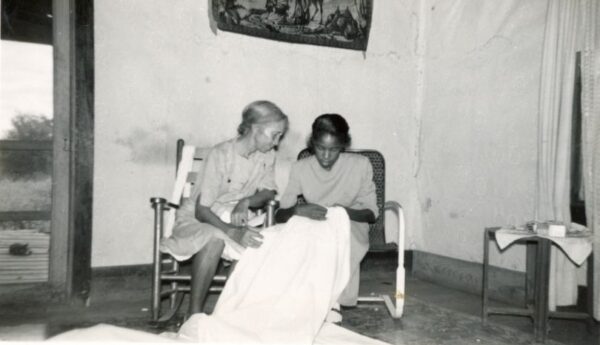
One family loading their luggage into a Cooperative Extension Service Vehicle
Meticulous data entry
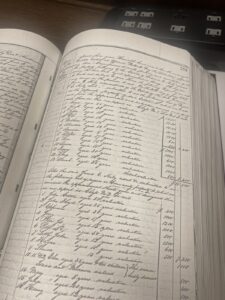
The CE&HD Collection contains documents, maps, and photographs that date back to the 1920s, and the county agents wrote about all their activities–from growing crops, to raising farm animals, to constructing houses. The agents also maintained meticulous records that detailed how much money they spent on each project.
100 years of records
I found it very interesting how the cursive handwriting was readable, and my work on the Digital PV Panther Project has instilled a better appreciation for the manuscripts in the archives. Indeed, I am grateful that these collections were preserved and not thrown away, and I look forward to making this collection available to researchers. Some of the records are over one hundred years old!
Children at Morgan School (Guadalupe County) exercising in 1933 exercises, with agent supervising
@digitalpvpantherproject Massive! The manuscript collections in the PVAMU Archives are massive in their scope and breadth! The Cooperative Extension & Home Demonstration Collection contains more than 100 linear feet of photographs, maps, and documents that date back more than 100 years and cover over 45 counties in Texas! #dppp #digitalpvpantherproject #hbcu #pvamuhistory ##pvamu##hbcuhistory##digitalcommons##archives##media##campus##digital ♬ Mission Impossible Theme (Movie Trailer Mix) – Dominik Hauser
I am also proud to work on the social media team for the Digital PV Panther Project. I have created multiple TikTok videos showcasing my work as an archival assistant, and I am glad to put my skillset to work promoting the archival collections at PVAMU. For example, the TikTok video to the left demonstrates the vast amount of archival media in the CE&HD Collection.
This project also gave the opportunity to work with some amazing scholars of African American History, specifically anthropologist Myeshia Babers–a professor of Africana Studies at Texas A&M University, who conducted interviews with several members of the team. Dr. Babers agreed to conduct interviews with archival assistants shortly after the project began, and she plans to edit the interviews for future publication online. In fact, we hope to expand the scope of our social media output by creating a Youtube channel, and we plan to publish the interviews with Dr. Babers to get us started. During my interview on September 2, I explained about my work thus far on the project, and I prognosticated about what I expect to get out of this job. It should be interesting to compare my initial interview with the interview we plan to conduct at the end of the project.
The following week, Dr. Moore organized a team meeting with University Archivist Ms. Phyllis Earles, who invited Dr. Musa Olaka, the library director, and Karl Henson, the assistant library director, to speak to us. Dr. Olaka told us about the benefits and opportunities we had working on this project, and he explained that Dr. Moore had written over $700,000 in grants to fund this project and hire students to do the work of historic preservation at PVAMU. None of our archival collections are processed, and the only real finding aids that we have are the ones that Dr. Moore wrote a grant to produce last year. Dr. Olaka told us that other students who worked for Ms. Earles and Dr. Moore had gone on to stellar careers, and his words have certainly inspired us to work harder and achieve the goals of the Digital PV Panther Project.
At the meeting, we also talked about our progress on the project, and Dr. Moore compiled a project guidebook, which contains rules, guidelines, and instructions for various aspects of the project–from social media curation, to blogging, and the addition of media to Wordpress. One of my fellow archival assistants, Malachi McMahon, also took a moment to stress the significance of the project. His research has provided some of the most insightful and engaging blog posts to date, and it shows in his drive and determination to make positive changes in the world.
On September 27, I created a Tiktok video about the Abner Davis Memorial, which is the focus of Malachi’s best blog post to date (Click HERE to read it). The memorial is located on campus in front of the George Ruble Woolfolk Building. Abner Davis was a member of the varsity football team in 1927, and he broke his neck while trying to make a tackle against Texas College on Thanksgiving Day. He passed away due to the severity of the injuries. Since he was recognized as a great example of student success at PVAMU, his classmates and teammates created several different memorials over the years to their fallen hero.
@digitalpvpantherproject Check out the Abner Davis Statue located in front of the G.R. Woolfolk Social & Political Science Building on campus! 💜💛 #dppp #pvamu #hbcu #pvamuhistory #hbcuculture #history ♬ original sound – DIGITALPVPANTHERPROJECT
In the past couple of weeks, my work has focused on creating inventories spreadsheets for the numerous boxes in the CE&HD Collection, and I have also helped edit the finding aids of 31 former professors and administrators. We hope to complete the finding aids before October 31st. I have also developed a list of ideas for upcoming social media posts and TikTok videos.
Though I have only been an archival assistant for two months, I have gained a sincere appreciation for historic preservation during that time, and I have developed a much clearer understanding of the importance of the Digital PV Panther Project.
We plan to prevent the erasure of African American History by all means available to us, and I could not be more excited about the future!
The Archival Experience
The Archival
Experience
By Hannah Harden
My historical awareness about the history of HBCUs has seriously expanded since I began to work on the Digital PV Panther Project. When I showed up the first day, I did not know what I had gotten myself into this semester. I was eager to work on campus, as well as learn more about the project, but I remained unclear on the scope of work. To start, I helped the University Archivist Ms. Phyllis Earles with administrative tasks, such as creating labels for time sheets and creating a document detailing kitchen etiquette to be displayed in the staff kitchen area.
Being a Kinesiology major, I have only taken a course in Texas history at PVMAU. Thus, I had little awareness of institutional history. I knew that the university was founded in 1876, but I never knew about the depth of historical collections in the PVAMU archives.
Much of my archival processing work has focused on creating inventories for the Cooperative Extension & Home Demonstration Collection, which contains images, maps, and documents dating back to the 1920s. The collection also consists of travel sheets and personal letters written by people on the campus of PVAMU and surrounding counties. Seeing the substantial size of the archives has given me a clearer picture of the scope of PVAMU history, and I now realize how much more important it is to preserve it and have it accessible to the public.
Dr. Moore also assigned me to work on the social media team with Kasedi Eason, Noah Jackson, and Malachi McMahon, and I curated content for Instagram and TikTok. One of the first videos I created and edited for our page focused on the Wilhelmina Delco Exhibit on the 4th floor of the John B. Coleman Library. Since most students have likely never visited the 4th floor of the library, this TikTok video allows them to experience a taste of the exhibition.
Dr. Moore also introduced us to a social media manager called Loomly, which helps you curate content for multiple social media accounts at once as well as schedule to post them for weeks in advance. We use Loomly for all our social media posts on Instagram, Twitter, Facebook, and LinkedIn.
@digitalpvpantherproject Check out PVAMU's newest exhibit 'The Wilhelmina Delco Story' on the 4th floor of the library! 💜💛 #dppp #digitalpvpantherproject #hbcu #hbcuhistory #pvamu #pvamuhistory #archives #digitalexhibit #blogging #altavista #race #gender #class #research #digitalcommons ♬ Moonlight Serenade – Glenn Miller
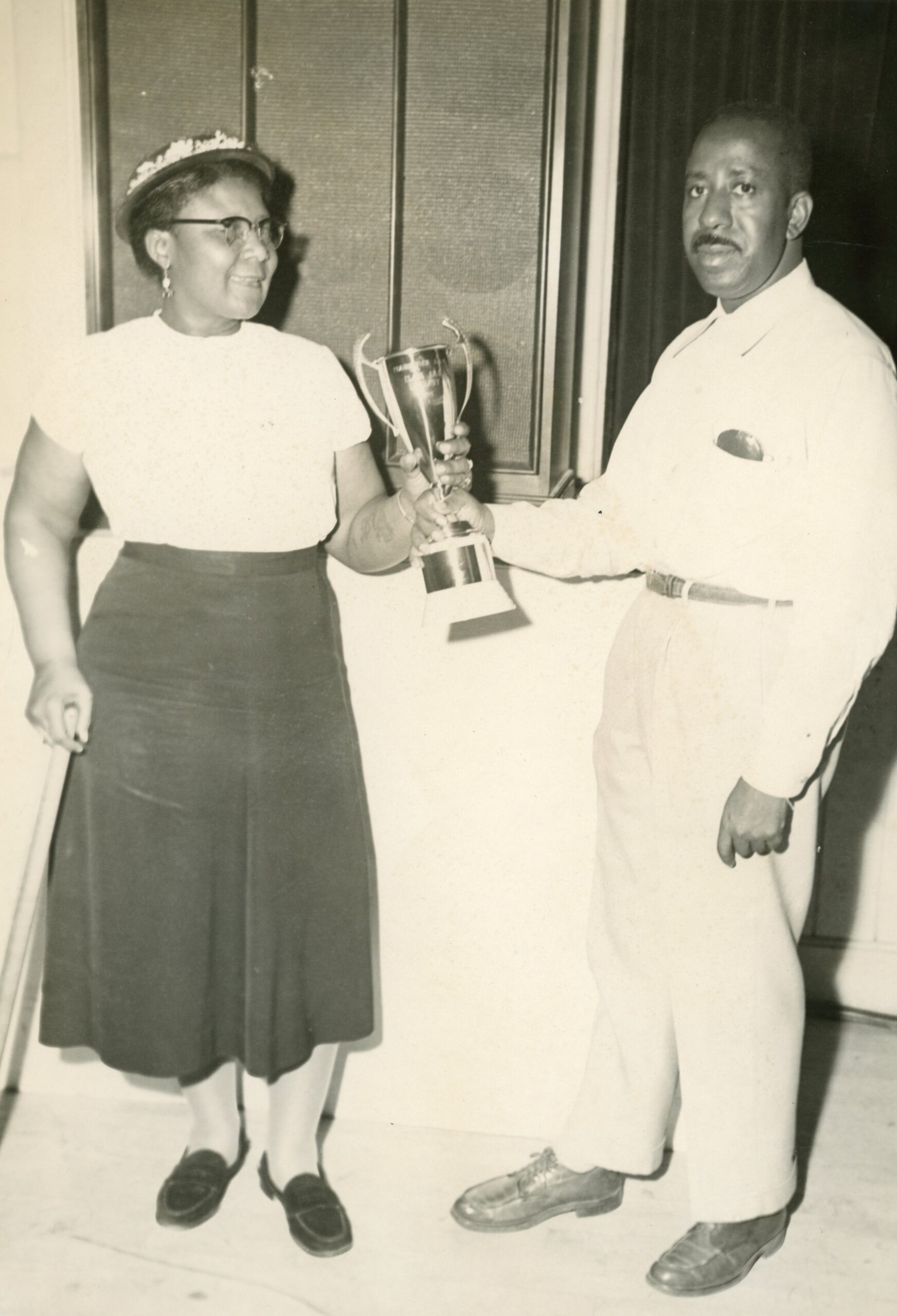
Dr. George Ruble Woolfolk delivering a much deserved reward in the 1950s
For a couple of weeks, I went through the archive boxes and created new inventory sheets as well as edited some that were done years ago. Writing a key of which boxes had pictures/maps included makes it easier in the future for finding certain documents in each one. In these boxes, many pictures are starting to deteriorate. That is why it is so important for us to be going through these documents to be able to scan them and make them digital.
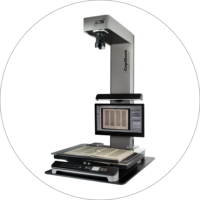
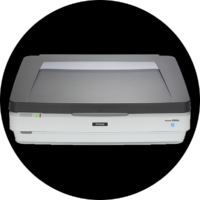
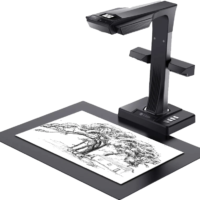
Recently, I have learned how to scan Prints and Slides on the new Epson 12000XL flatbed scanner. We can now scan the historic photographs in the Tom Godwin Collection, and we have partnered with Getty Images to license them to their clients. Not only will we preserve the photographs and prevent their deterioration, but we will upload them to the Getty Images digital content management system and allow the larger PVAMU family to have access to them as well.
Overall, working on the Digital PV Panther Project has taught me so much in such little time. I cannot wait to see what comes in the future for this project and how far we can bring this information to the campus and the public. This project is exceedingly important to the university as well as the surrounding communities, and I am dedicated to ensuring that these collections are preserved for future generations.
Historical Consciousness and the PV19
By Caleb Brookins
You cannot put a price on a good education. Indeed, universities across the nation consider a good understanding of history one of the core sets of knowledge each undergraduate needs to obtain a bachelor’s degree. In my first few weeks working on the Digital PV Panther Project, I have gained access to a vast amount of information, which remains hidden away from researchers, students, and other stakeholders in the dark vault of the PVAMU archives. In my nascent quest to develop archival research skills, I have also gained much more clarity about the importance of the Digital PV Panther Project. By analyzing the events of an important, yet understudied, chapter of local voting rights history, this blog post demonstrates that historical understanding is necessary to achieve a heightened state of consciousness. This is the story of the PV 19.
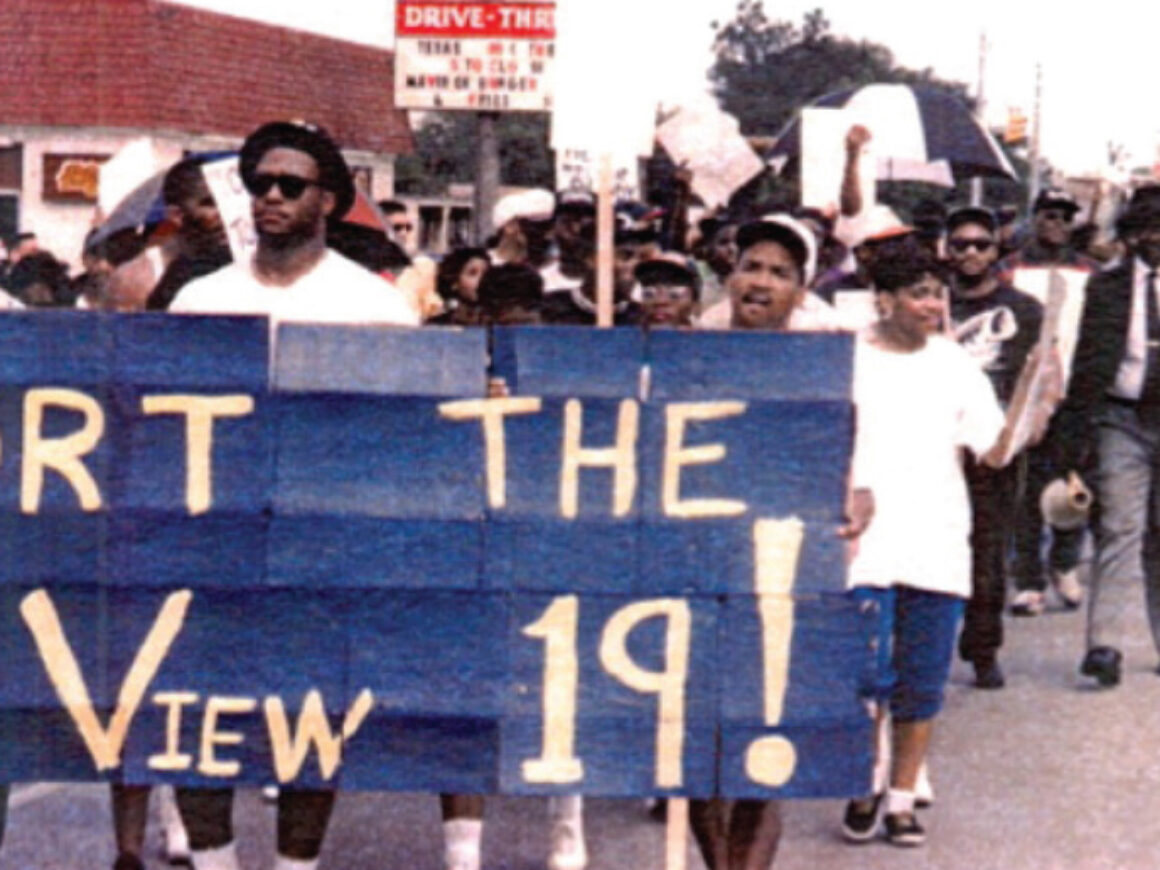
Prairie View A&M students protest the county district attorney’s attempts to prosecute their fellow students for voter fraud in 1992.
(Left) Brizjon Wilright and Kendric Jones held signs outside the Willie A. Tempton Student Center at Prairie View A&M to encourage other students to vote in 2016
The Prairie View Panther, April 1992.
Voting is crucial in a healthy democracy. Whether it’s a national, state, or local election, the significance of high voter turnout cannot be stressed enough. In 1928, Democratic Party Presidential Candidate Al Smith openly appealed to Black voters during his failed bid for the presidency. Since the Civil War, African Americans had aligned politically with the Party of Lincoln, the Republican Party, due to its core stance on abolishing slavery. During World War I, however, the Great Migration of African Americans out of the Jim Crow South created large voting blocs in several northern states, and the Democratic Party began to covet the Black vote in key swing states by appealing to the interests of African Americans.
African American’s love affair with the Democratic Party reached a milestone with the Voting Rights Act of 1965, which brought an end to the disfranchisement of African Americans on the national and state level. The number of registered Black voters rose significantly, and conservatives in power have attempted to dilute their voting strength in numerous ways ever since. In Waller County, Texas, for example, the students attending Prairie View A&M University repeatedly find themselves in the middle of an ongoing fight for the very soul of democracy.
Prairie View A&M students protest the county district attorney’s attempts to prosecute their fellow students for voter fraud in 1992.
“A horsewhipping is what Frank Jackson needs,” argued Texas Advocate editor Mary Levy in mid-1992, “for misconstruing the facts to the media and, most importantly, to the students.” Having won the Democratic primary against Richard Frey (votes: 782 to 475), Frank Jackson faced Republican Ron Leverett for the seat of Waller County Commissioner in November 1992, and his campaign received national attention due to his support for 19 PVAMU students, who had been indicted locally for aggravated perjury and illegal voting.
In the spring of 1992, a host of PVAMU students had filled out registration cards during a voter registration drive, assumed they had concluded the process, and with confidence proceeded to vote. When their names did not appear on the registration roll, they signed affidavits stating that they were registered to vote. The voter registration office subsequently notified Assistant Waller County District Attorney A.M. “Buddy” McCaig. On March 26, 1992, he filed indictments against twenty-three individuals for aggravated perjury and illegal voting, and he issued subpoenas for them to appear before grand jury on April 2nd.
Prairie View A&M students protest the county district attorney’s attempts to prosecute their fellow students for voter fraud in 1992.
The April 1992 March on Hempstead
Comparing it to the March on Washington, Prairie View Panther Editor-In-Chief Michell Johnson reported that “hundreds of students walked and drove caravan-style to Hempstead…accompanied by the Prairie View police, a fire truck carrying refreshments for the demonstrators and an ambulance for those who could not endure the heat…Many students armed with their voter registration cards lined up to exercise their right to vote. “It felt good,” admitted one student, “to be part of a unified effort to improve the rights of students at Prairie View.”
No one has ever questioned the rights of students at the University of Houston or Texas A&M to vote, but the issue is constantly raised about the students who attend PVAMU. Since the 1880s, voting boundaries in Waller County had split up the vote in the predominantly Black communities and given citizens little voice in government. Hempstead was divided into two voting precincts and Prairie View was divided into three. Students were forced to vote at two separate locations depending on which side of the campus they lived.
As a result of the 1980 census, however, the county was redistricted to maintain an equal number of voters in each precinct. Federally required redistricting of the voting precincts in Waller County gave Prairie View and the surrounding community a substantial amount of voting power. At long last, Waller County would have a representative government in 1992.
Of the 23,390 population, 11,993 were white, 8,609 were black and the rest were Hispanic or Asian. Fear struck deep in the hearts of the majority.
The Prairie View Panther featured a regular section called “Speak Out!,” which provided students a space to publicly voice their criticisms. In the April 3, 1992 edition, one of the PV19, Donna Shelton, took the opportunity to comment on her indictment as well as the impact on local politics.
As one of the 19 students who are being falsely accused of registration fraud, by the Waller County D.A, Albert “Buddy” McCaig, I feel that it is time for me to speak out!
Acting within the Constitution and exercising our right to vote, I, we were brought up on criminal charges. These charges hold penalties of two to ten years in prison, fines, or probation.
This is ludicrous. I feel that this is a ploy used by our enemies in the Waller county D.A’s office to harass and discourage Prairie View student from voting. Do you realize that there are over 5,000 students at P.V., and that if we acted as a whole, we could have an immeasurable impact on Waller county? Well I do, and I hope that you don’t let this infringement on our voting rights go unchallenged.
As students, in the past we have not been going to the polls enough. However, thanks to the strong leadership of the SGA and the extended P.V. family, who have been persistent in the struggle for students to be able to participate in the political system. But now we are now being discouraged from exercising our franchise. say to all P.V students, don’t let this incident stop you from doing the right thing, empower yourselves. If you are not registered, then do so, it is your right.
I would like to thank Mr. Frank Jackson, who has been at the forefront of this struggle, and I would also like to thank the entire Prairie View student body for being behind the P.V.19!
The fight is not over, we have been indicted. Just remember that if we don’t I take a stand today, there may not be a chance to do so in the future. The run-off elections are April 14 “We’re proud and we’re Black, and we ain’t going down like that!
Reflecting the increasingly frequent, unsubstantiated claims of voter fraud since 2016, the published response of Waller County district attorney McCaig in the Prairie View Panther demonstrates his efforts to dissuade PVAMU students from voting. In the open letter, which he asked be printed in its entirety, McCaig admitted to receiving a “great outpouring of support from many of the permanent citizens of Waller County,” most of whom did not “want their legally cast votes to be diluted by someone who is not a legal voter.” Attacking the 1979 SCOTUS decision in Symm v. United States, which allowed college students to vote where they attended school, McCaig argued, “it’s bad enough being forced to accept the fact that transient students living in a dormitory for a couple of semesters, paying no property taxes, have a right to vote in Waller County (when they should be voting at home) without having county citizens put up with illegal voting on top of that.”
No evidence of voter fraud has come to light to substantiate claims since 2016, and no evidence of illegal voting came to light in 1992. The PV19 were the victims of voter suppression tactics, and the same tactics have been resurrected since 2016 to suppress the voting rights of minorities. By examining the digital resources available about the PV19 and analyzing them in light of contemporary voter suppression efforts, this blog post has made clear that a better understanding of history is crucial to making confident political decisions. Consider where PVAMU is located and the history behind it. If we really put everything in perspective by stepping back and acknowledging the past, it is not difficult or far-fetched to see the prejudice oozing out of the county. In closing, I want to reiterate Donna Shelton’s call to action, which still rings true today:
We are now being discouraged from exercising our franchise [but] don’t let this incident stop you from doing the right thing, empower yourselves. If you are not registered, then do so, it is your right…We’re proud and we’re Black, and we ain’t going down like that!
Notes:
Albert M. McCaig, “McCaig on the PV 19,” The Prairie View Panther 69:7 May 1, 1992, p.7.
Donna Shelton, “Speak Out! One of the ‘PV 19’ Speaks to Voters,” The Prairie View Panther 69:5 (April 3, 1992), p.1.]
Morenike Efuntade, “Prairie View is in New Precinct,” The Prairie View Panther 68:17 September 27, 1991, p.1.
We’re Hiring!
Student Hourly Assistant | Center for Race and Justice | Archival Assistant
The Student Hourly Assistant, under general supervision, will process and digitize collections, curate social media content, transcribe oral histories, conduct archival research, create video and audio recordings, compose blog entries about their work, and serve as public ambassadors for the Digital PV Panther Project. We are seeking students with respectful dispositions who are mature, punctual, self-starter, teachable, honest, and can work either independently or as part of a team. Each student must have an eye for detail and be respectful of archival media
Hourly Rate of Pay: $13.00
Job Posting Close Date: 10/05/2022
Our Team, Our Work
Application Information
Responsibilities:
Required Education and Experience:
Preferred Education and Experience:
Preferred Knowledge, Skills, and Abilities:
Required Attachments: