Paying Respect at the Abner A. Davis Memorial
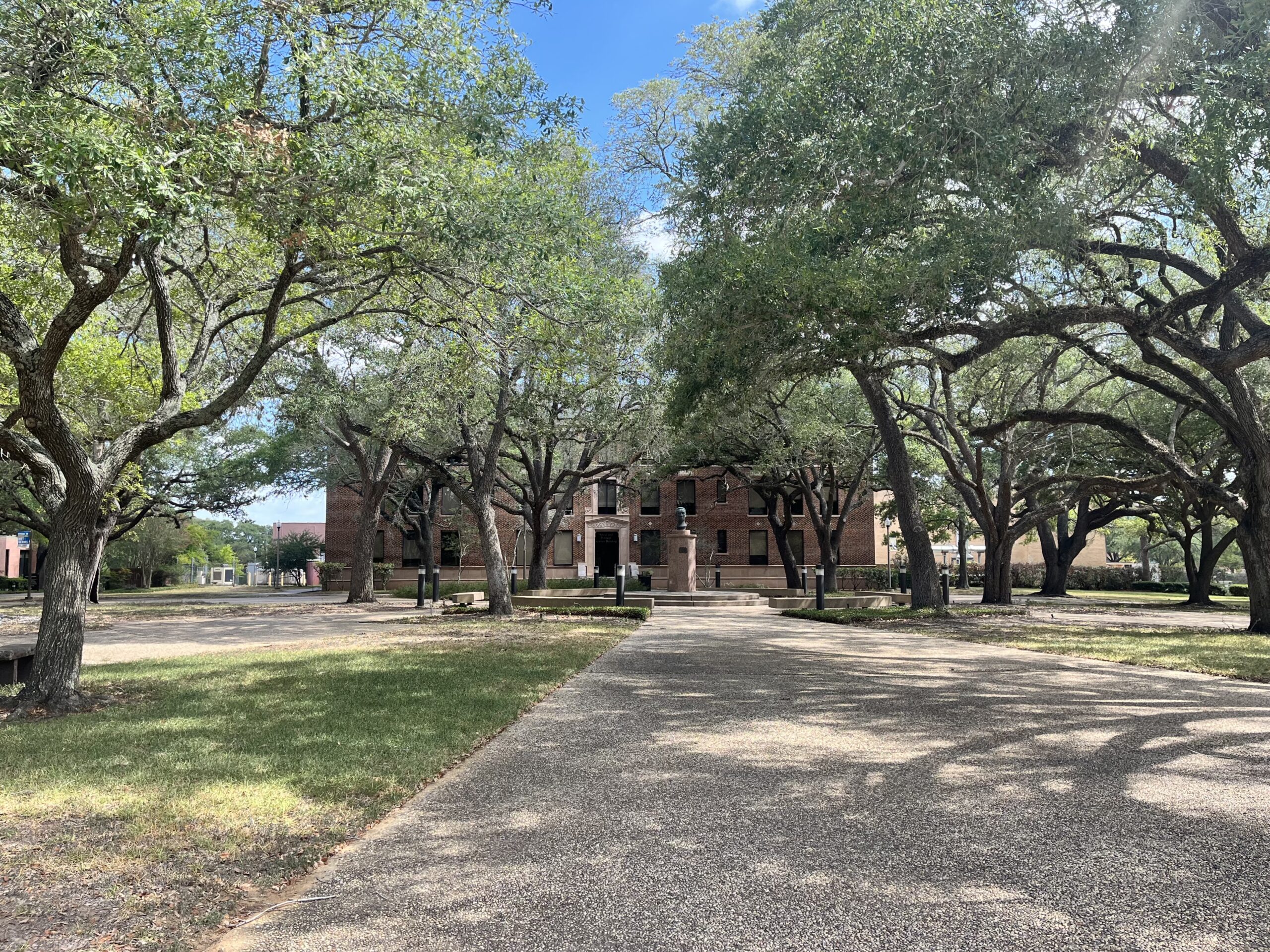
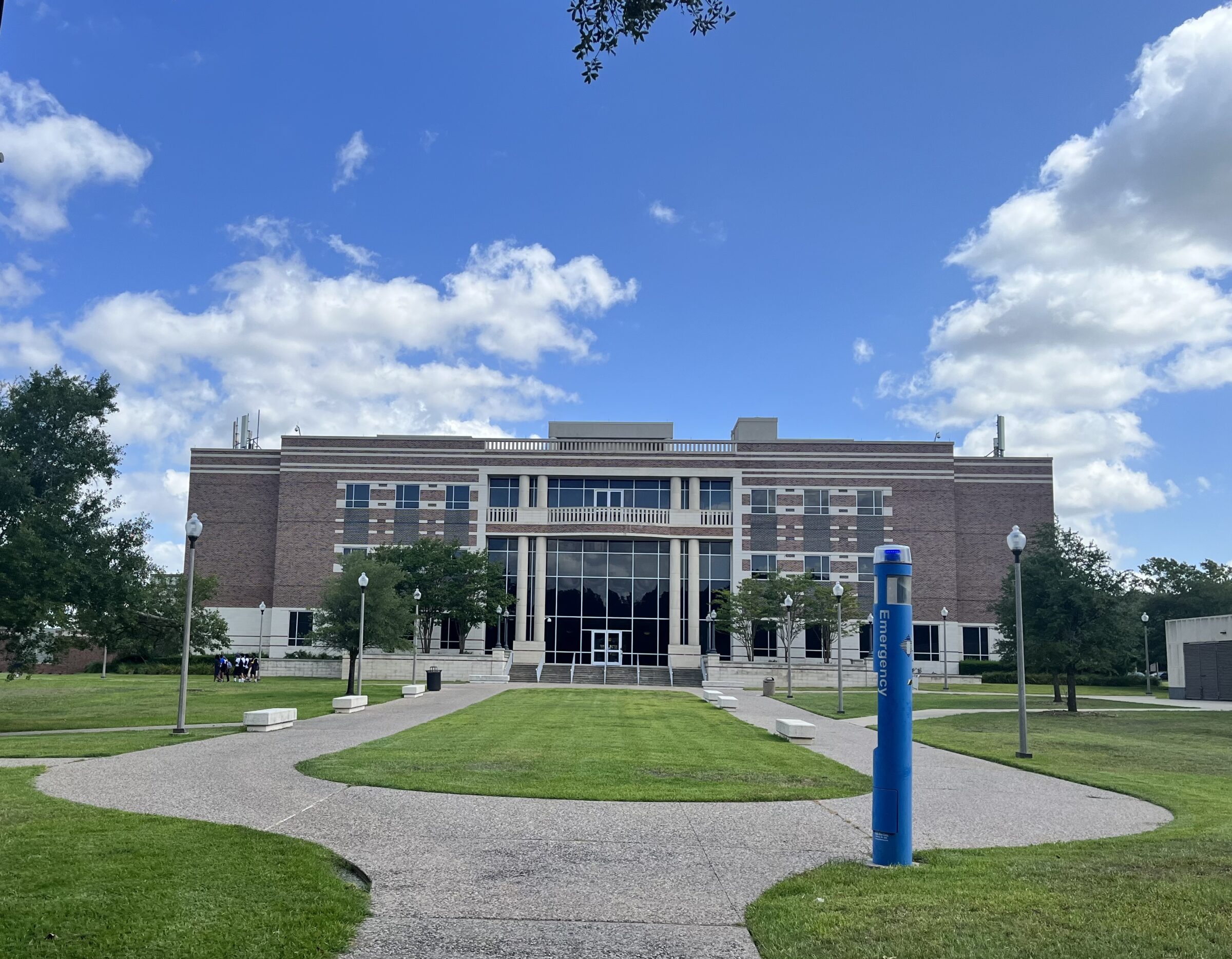
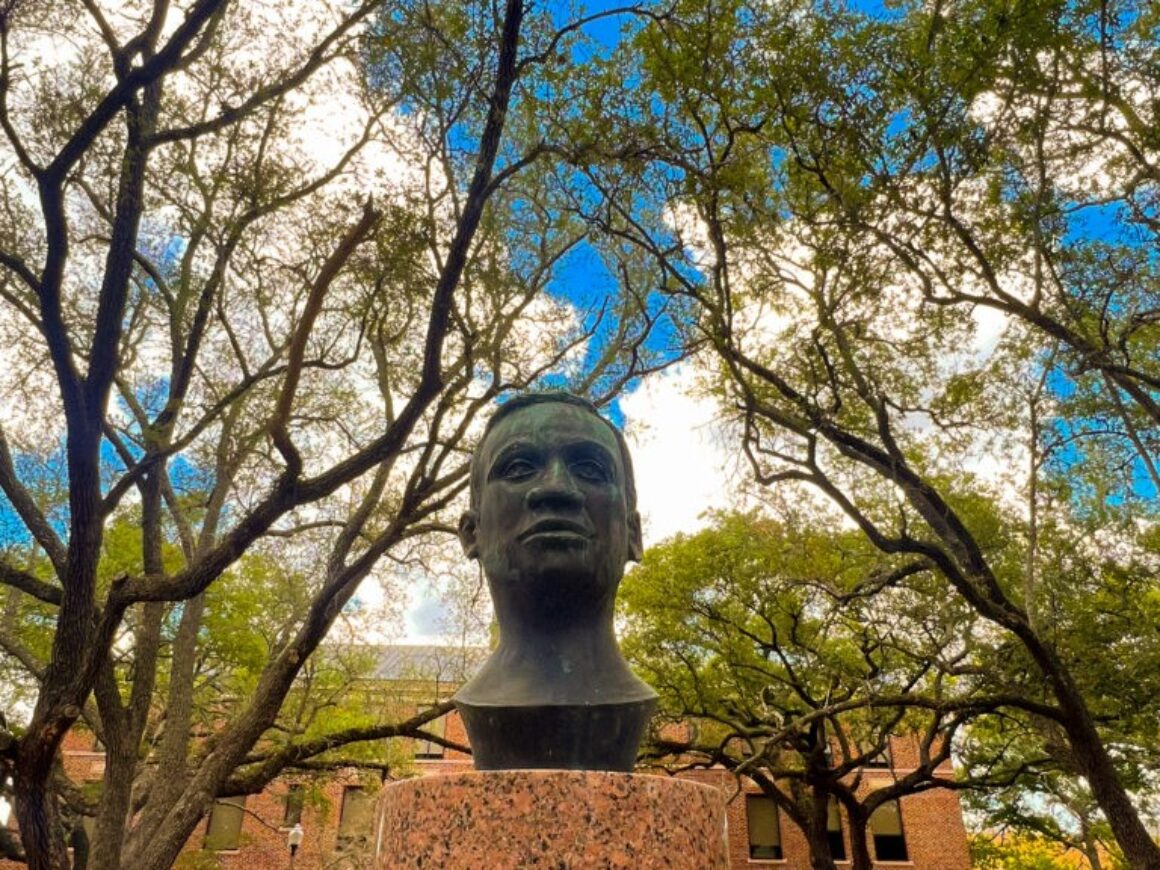
The Abner A. Davis Memorial has existed in one form or another on “The Hill” in front of the George Ruble Woolfolk Building at Prairie View A&M University since his death in December 1927. As a student at PVAMU, I have taken many walks across campus to get from my room in University Village Phase 3 to my morning classes. Since I lived at the back of campus, I had to pass Mr. Davis and the fountain quite often. Though I passed his memorial on numerous occasions, I never really took the time to learn about the history of the memorial or the man. This blog post intends to shine a light on a “gentleman, clean sport, athlete and ideal student,” as one former teammate referred to him, as well as the history of historic preservation and memorialization at PVAMU.
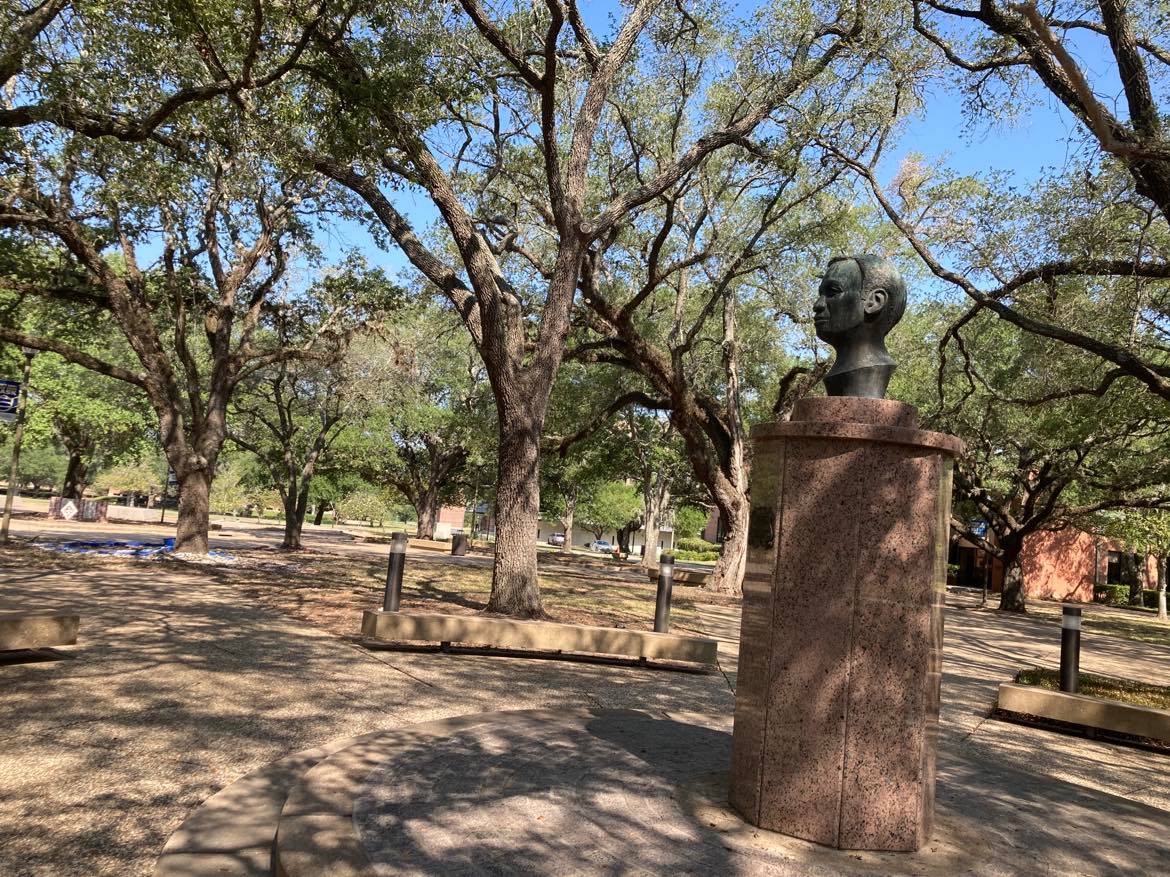
(Photo: T. DeWayne Moore, 2022)
Abner A. Davis was a member of the varsity football team at Prairie View A&M University in 1927. The Panthers were especially good that year. In an October 15, 1927 issue of the student newspaper, one writer exclaimed: “Never before in all footballdom at the college did the Prairie View Panthers show better form and finer spirits than have been shown this season. Vigorous, springy, and full of grit and fighting determination, the Panthers will be greatly disappointing to everybody if they do not smash and stop every gridiron machine that confronts them.” To view the entire article, please click HERE
In a game against Texas College the following month, Davis went to make a tackle on the opposing team and was severely injured during the play. He was hit in his neck by the offensive player’s knee, leaving him paralyzed from the neck down. Since his injury came in the middle of an away game, the Panthers finished playing the game and carried Davis back to campus. It’s unclear whether or not the team was victorious.
The doctor who treated Davis from November 24 through December 5 stated that he suffered from “paralysis” stemming from the “fracture or displacement of the 3[rd] & 4th cervical vertebrae.” While the doctor confirmed his diagnosis with an X-ray, Davis underwent no surgery prior to his demise on December 5. According to his death certificate, Hempstead undertaker E.L. Watson removed his remains for burial to the city of Eagle Lake, Texas on December 8.
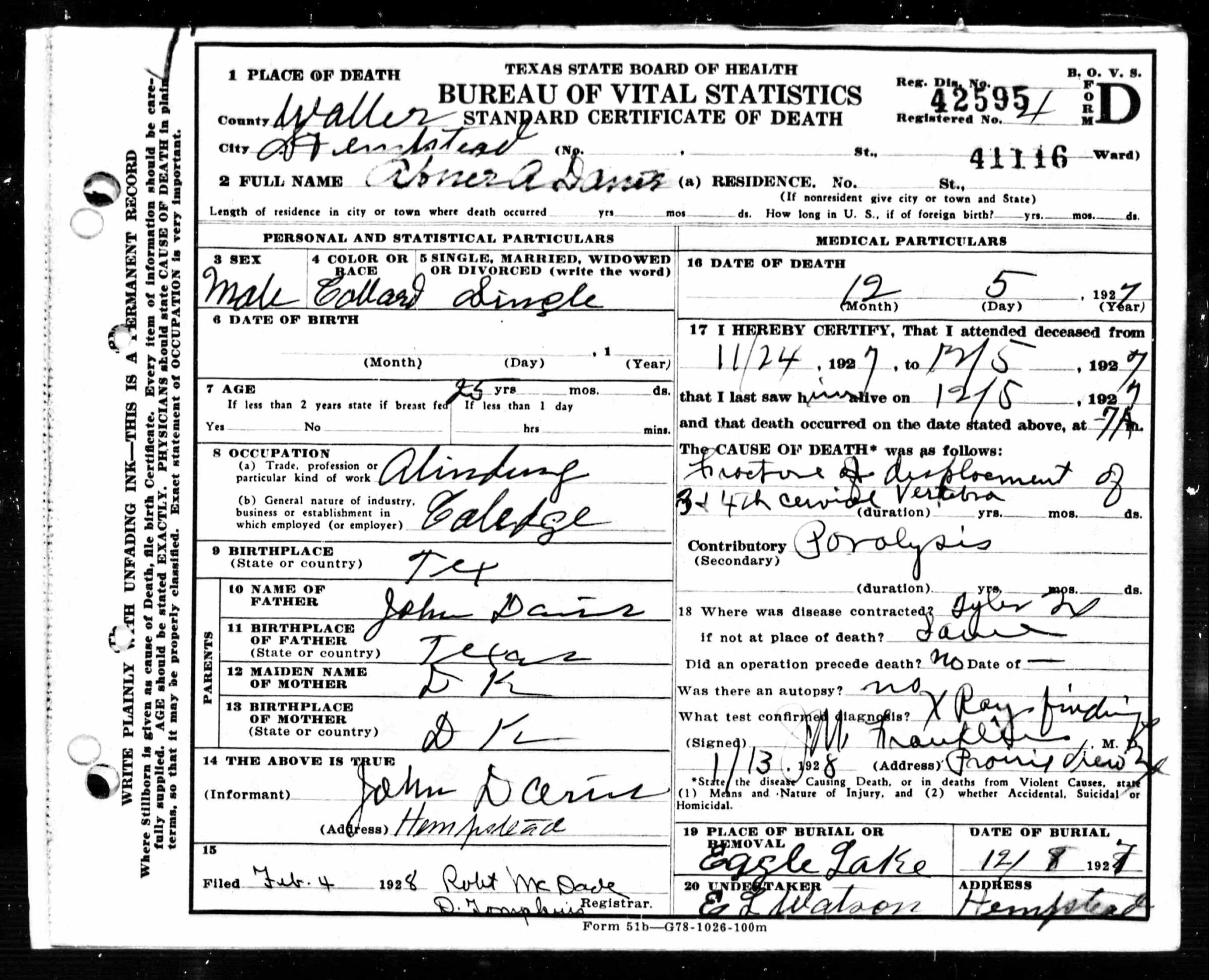
In his memoir, Down Memory Lane: The Story of Edward Bertram Evans, Sr. and the Early History of Prairie View A & M University, former university president and professor of veterinary science and medicine Edward Bertram Evans claims that the final remains of Abner Davis were laid to rest in his hometown of Spanish Camp, a small hamlet that sits an estimated ten miles outside of Wharton, Texas. Spanish Camp is located about 22 miles southeast of Eagle Rock. Indeed, the exact location of his grave remains the subject of debate. In a March 12, 2012 article in the Beaumont Times titled, “Where’s Abner?,” David Lisenby reported that the librarian at the Alma M. Carpenter Public Library in Sour Lake, Texas, who was on a mission to find the descendants of Davis, believed that he was buried somewhere in the town of Sour Lake near the city of Beaumont, Texas. Lisenby does not reveal the source of this information, and it directly contradicts the information on his death certificate.
Even though no one has ever found Abner Davis’s headstone, his classmates at PVAMU have memorialized his legacy in numerous ways over the years. In a 1933 issue of the Prairie View Panther, one author wrote a poem about the gridiron hero. To view the original poem, please click HERE
IN MEMORY OF ABNER DAVIS (P. U. Hero)
Sleep, 0 brave one, in glory’s field,
Time to your name shall honor yield;
The summer shall their blooms impart.
To fade above each mold’ring heart
And fading, mix their lustrous charms
With dust that bore heroic arms.
In a January 1934 issue of the Prairie View Standard, one of his teammates L.C. Mosley penned a memoriam to Abner Davis, and he reveals that the first physical memorial to Davis came in the form of light. “The light in the center of the campus proper,” he explained, “is more than just a light to illuminate the path to the library. It represents the life of a gentleman, clean sport, athlete, and ideal student, Abner Davis, who was fatally injured in a Thanksgiving Day football game against Texas College in Tyler, 1927. The classes of ’29 and ’30 made it possible for this light to shine in its way as the living light of this football warrior had shone. The entire Alumni mourn with Henry Staton, A. J. Banks, M. C. Bates, S. Prince, L. C. Mosley, O. Mason, Jap Turner, G. Turner, J. J. Mark and Pop Singleton who started and finished the game that Abner started and could not finish.”
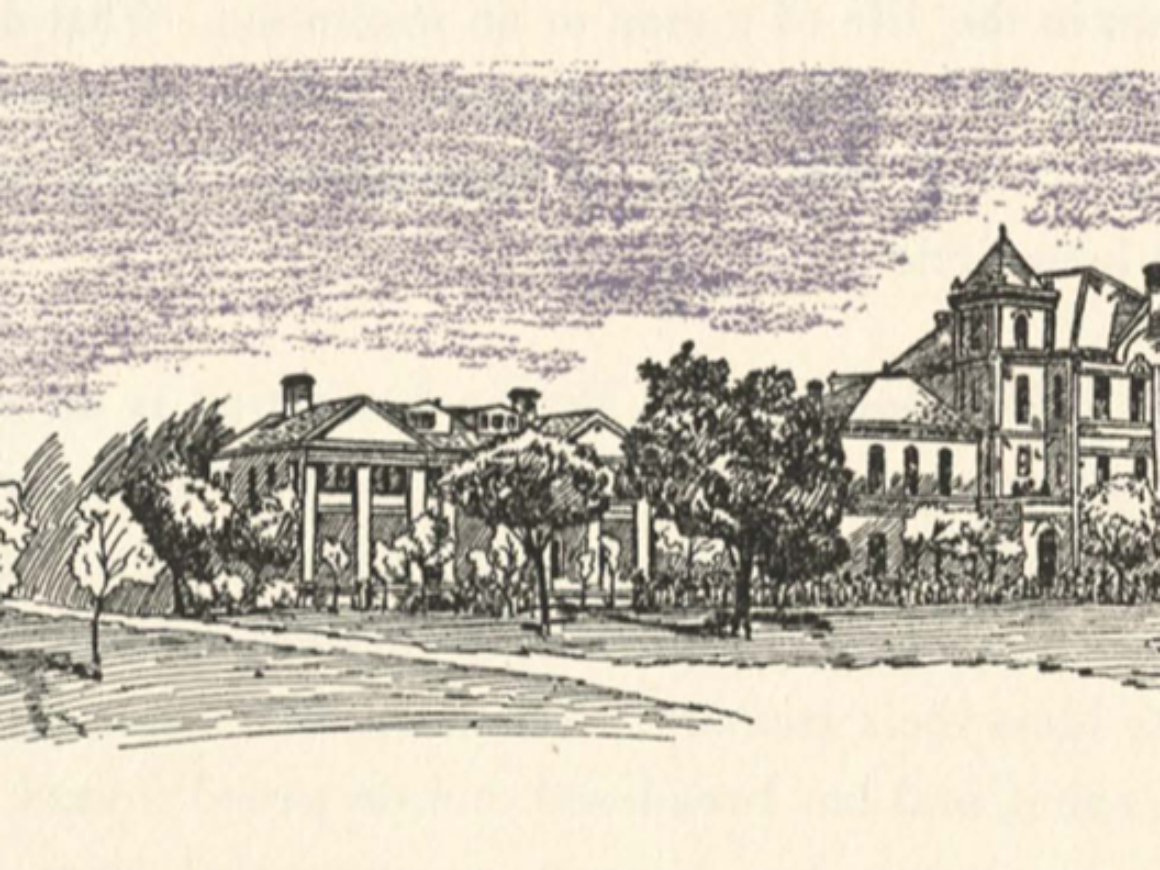
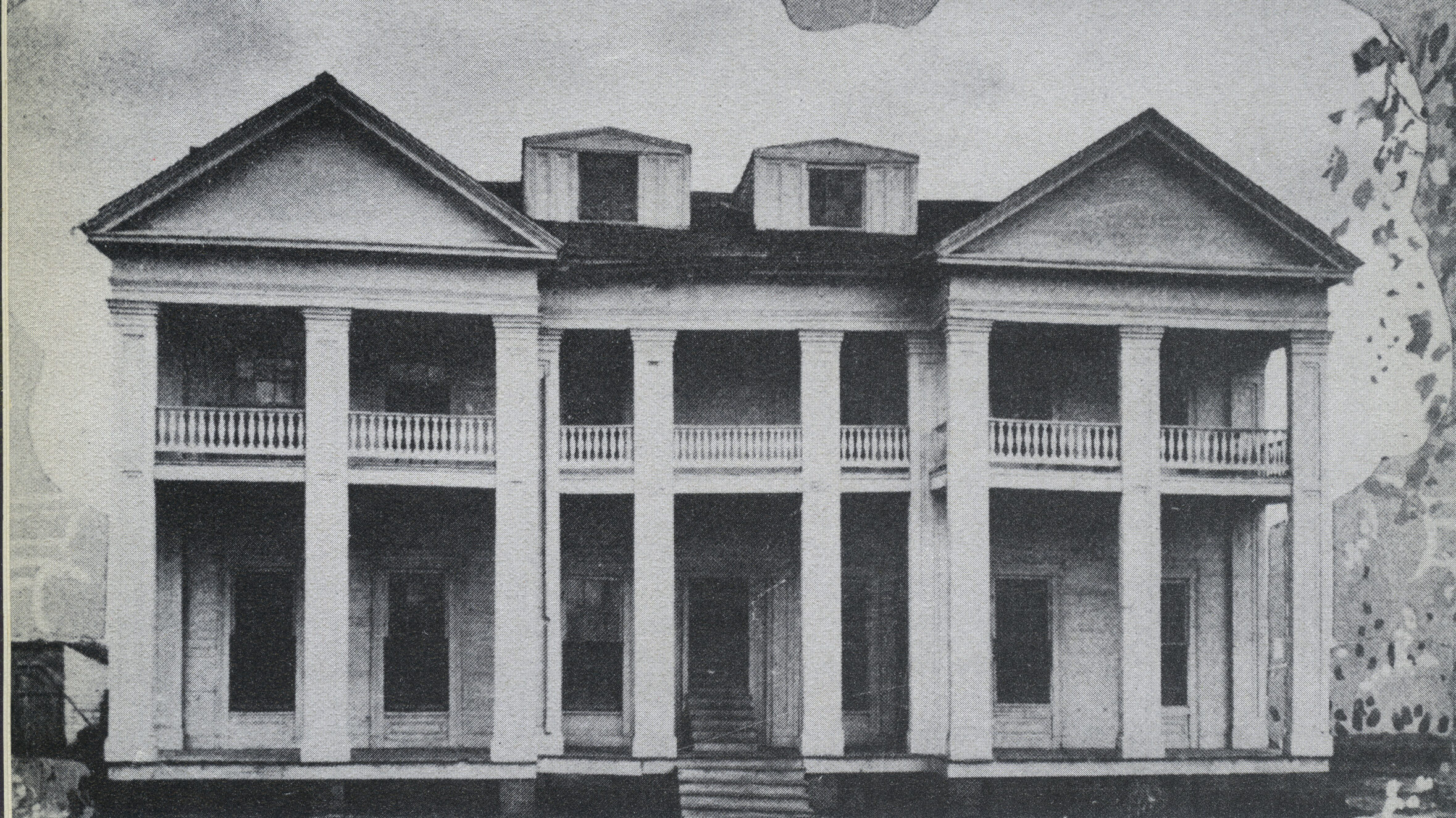
The demolition of Kirby Hall as well as “all wooden structures in the immediate campus area” in April 1934 (news about the razing of the slave mansion can be found in a newsletter HERE) provided an opportunity to install a new monument on “The Hill.” The teammates and classmates of Davis decided to replace the monument to slavery with a new symbol in the late 1930s.
A drinking fountain and memorial in honor of Abner A. Davis soon adorned the top of “The Hill,” and student organizations used the fountain as the site of many activities for the next four decades. In 1957, the Student Welfare Committee affirmed the need to beautify campus and spearheaded a “College Clean-Up Campaign involving both faculty and students in an effort to make Pantherland ideal.” Making the first step in this direction, the committee polished the Abner Davis Fountain and “put signs on the lawn asking students to use the sidewalks, thus avoiding making trails through the campus.” [For the entire article, please click HERE]
In 1961, PVAMU student Lois Moore noted that the center of the “campus is designated with a water fountain known as the Abner Davis water fountain. Many clubs and organizations meet periodically around this fountain…but many students on the campus do not know why these clubs meet here.” Moore also noted, “Although the fountain no longer exists as a water fountain, it is still the cultural center of the campus.” [For the entire article, please click HERE]
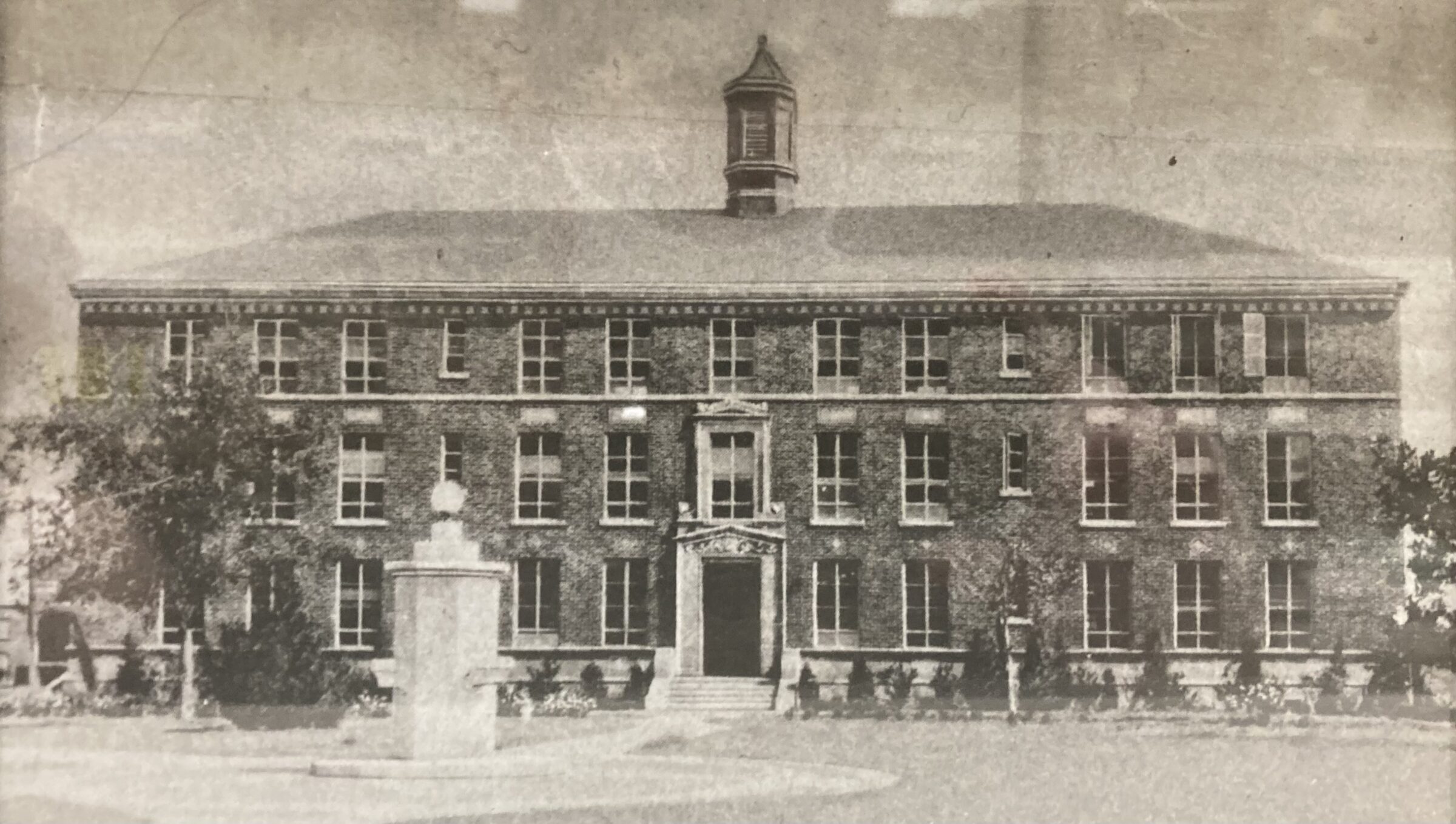
In March 1963, the LES BEAUX ARTS Cultural Club renovated the Abner Davis Memorial. The fountain, once stained and weather-worn, has now been refreshed for a new year. “This improvement has certainly played a great role in making the ‘center’ of the campus, all the more attractive, for our yearly high school visitors.” For more information, click HERE
On January 16, 1984, PVAMU observed the birthday of Martin Luther King, Jr. and organized a special program in the quadrangle area of the campus at the Abner Davis Fountain. For more information, click HERE
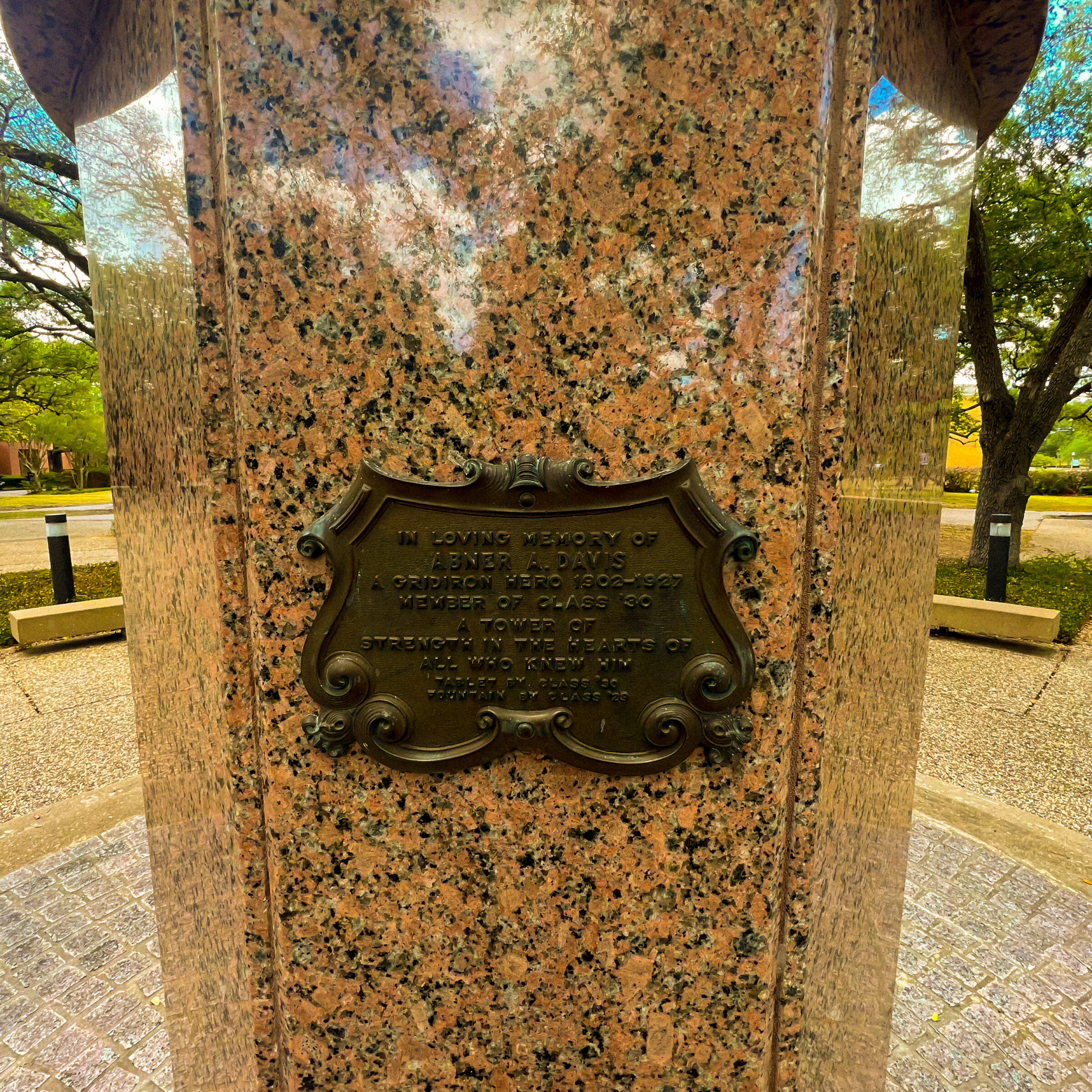
In July 1984, the Class of 1930 renovated the Abner A. Davis Monument and added the Texas Sunset Granite. For more information, click HERE
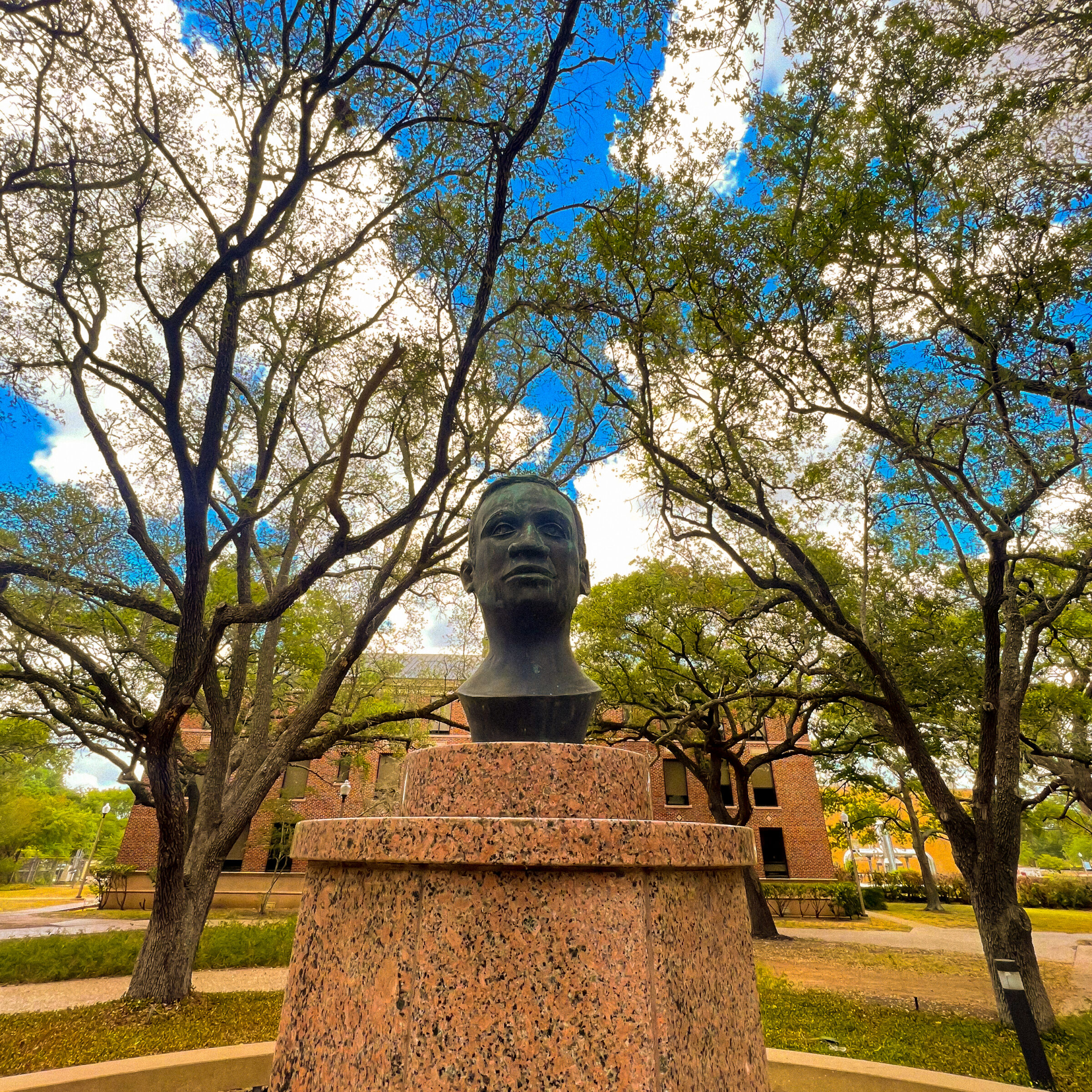
(Photo: Malachi McMahon, 2022)
The mystery about the location of Davis’ remains gives rise to many questions about the impact of racial segregation on his life and legacy. Being that his death occurred in the Jim Crow South, he would not have had access to quality medical care, and his death might very well have been prevented.
One day while walking across campus, I watched as landscapers blew freshly cut grass off the concrete walkway. It created a clean path for students. It was at this moment that I noticed the bust atop the Abner A. Davis Memorial was covered in spiderwebs, leaves, and dirt, and I started to wonder why no one on campus had taken the time to clean the statue. The grass is always freshly mowed and looks pristine. Indeed, the lawn on campus is cut and trimmed almost daily, and I rarely see any trash accumulation on the ground.
So I asked myself, “Why is the Davis memorial not well kept?”
The unsightly appearance of the Abner Davis Memorial was on my mind when I walked into work the next day for the Digital PV Panther Project, and I shared my concerns with Dr. Moore. I let him know about the condition of the memorial and that it wasn’t well-kept, and we agreed to take matters into our own hands and clean it up.
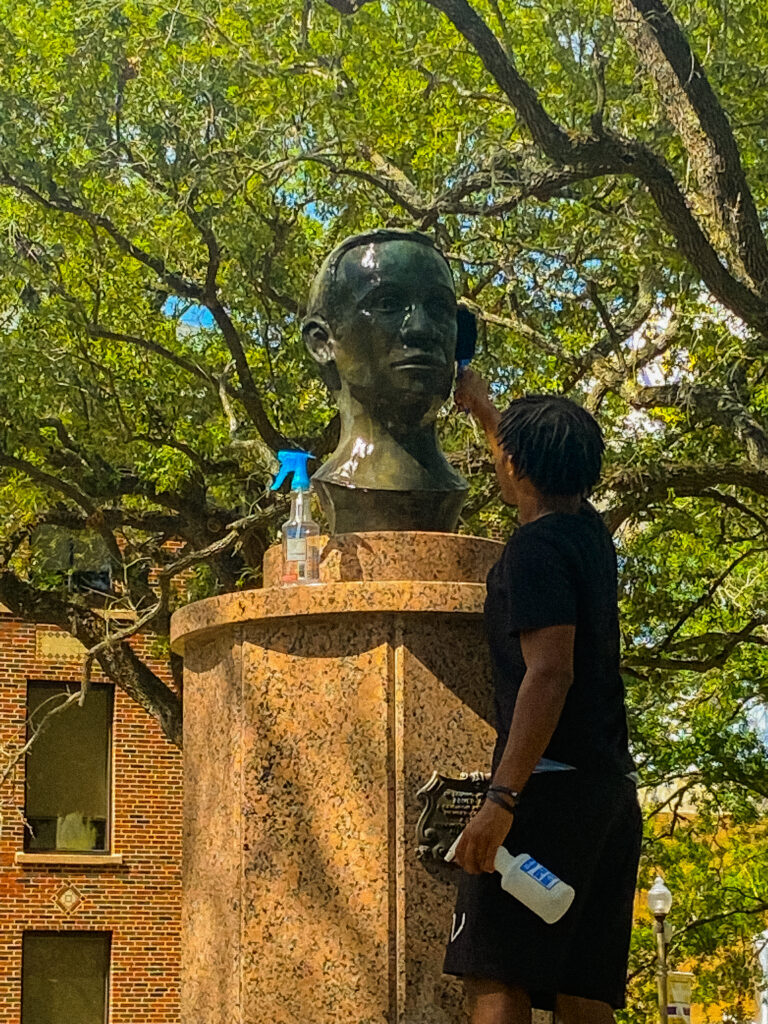
(Photo: Kalayah Jammer, 2022)
At the time, we did not know that we were following in the footsteps of many other students and faculty at PVAMU, who had been dissatisfied with existing preservation practices and made it a point to beautify the campus. Thus, we gathered some cleaning materials and headed for the memorial. We began by dusting off the spider webs, which had certainly built up for several years. Once we removed the spider webs, we sprayed the bust clean with water, and we cleaned it with D2 biological solution, an organic cleaning solution that removes fungi and provides a protective coating for the memorial. We also wiped the memorial clean from top to bottom with a soft-bristle brush. When we finished cleaning, I felt very accomplished and proud to have played a role in keeping the campus beautiful.
This job has given me a new perspective on what studying at PVAMU means. Many students, faculty, staff, and administrators have paved the way for us, and I believe other students should recognize that. If we are not careful, we will discount the sacrifices of the past. We must appreciate our history as an HBCU, and I will make strenuous efforts to share insights with my peers so that our heroes, such as Abner Davis, will never be forgotten.
Sincerely,
Malachi McMahon