Miss Mary G. Levy: Political Friction in Waller County
The "PV19" and the Charge of Voter Fraud
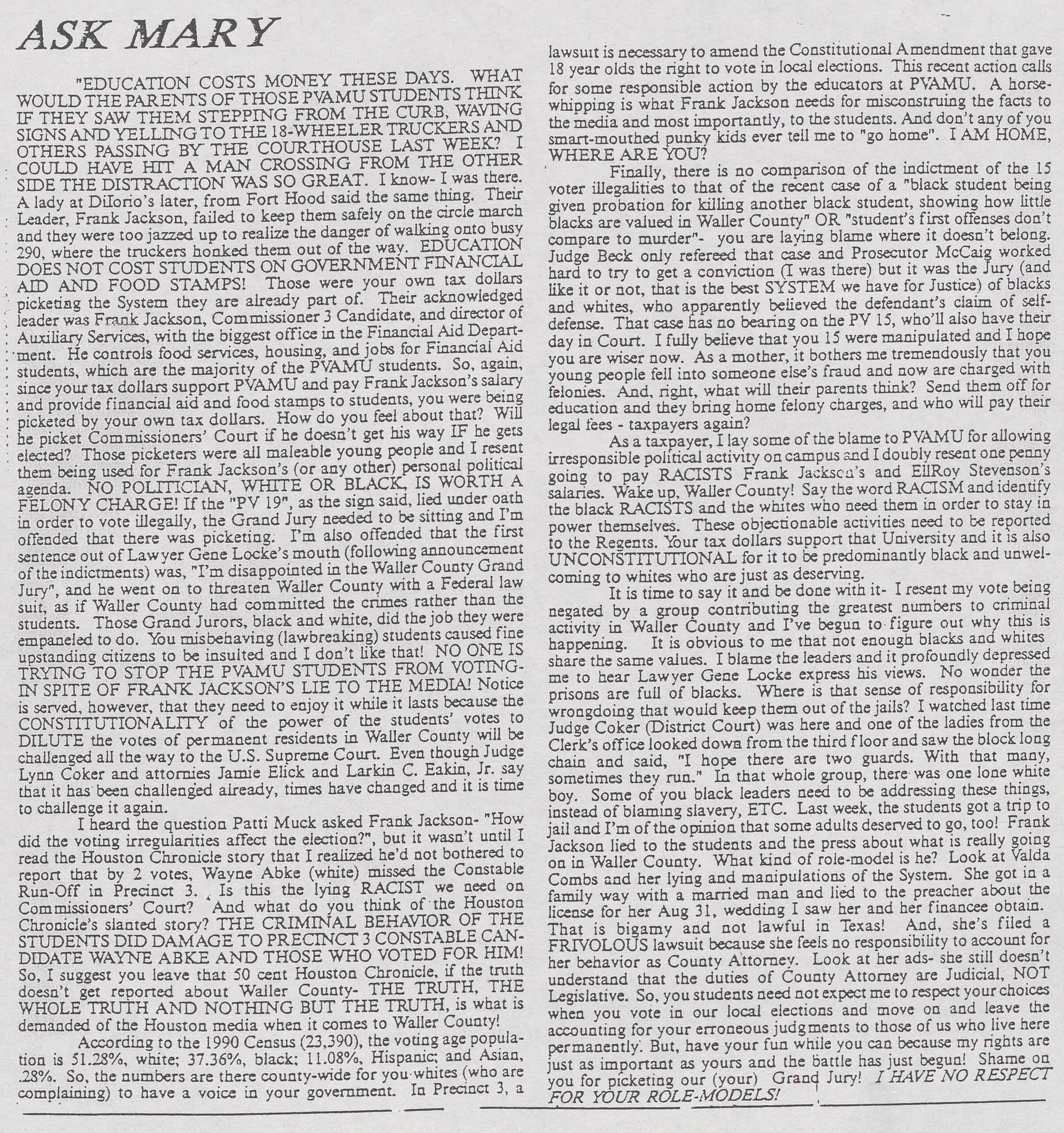
The article refers to the “indictment of the 15” (later expanded to 19, hence “PV19”). In 1992, students were encouraged to register to vote in a massive drive. Many believed they were registered, but when they arrived at the polls and found their names missing, they signed “challenge affidavits” to cast their ballots. Assistant District Attorney A.M. “Buddy” McCaig subsequently indicted 19 students for “aggravated perjury” and illegal voting—felonies carrying potential prison sentences of up to 10 years. The article reflects the local white establishment’s view that these students were “transient” and “lawbreaking,” despite the 1979 Supreme Court ruling (Symm v. United States) which had already affirmed that students have the right to vote where they attend college.
Political Power Dynamics: The Frank Jackson Run-off
The timing of the indictments and this article was politically calculated. Frank Jackson, a PVAMU administrator and future mayor of Prairie View, was running for County Commissioner against a 16-year white incumbent. The “voting irregularities” the author bemoans were essentially a mobilization of the Black student vote that threatened to shift the balance of power in Waller County. By labeling Jackson a “lying RACIST” and calling for his “horsewhipping,” the author (editor Mary Levy) was engaging in a defense of the “permanent resident” (largely white) political monopoly against a rising Black electorate.
Rhetoric of Economic Resentment and "Post-Jim Crow" Control
The author uses “taxpayer” status as a moral high ground to delegitimize student voices, arguing that because students receive financial aid or don’t pay property taxes, their votes “dilute” those of “upstanding citizens.” This rhetoric echoes Jim Crow-era “property qualifications” for voting. Furthermore, the author’s disgust with the PVAMU students—calling them “malleable” and “punky kids”—serves to infantilize Black adults and dismiss their political agency as mere manipulation by leaders like Jackson.
The charges against the PV19 were eventually dropped after a Department of Justice investigation and national outcry, including marches and media scrutiny. However, as the article illustrates, the culture of voter suppression in Waller County remained deeply entrenched. The same issues surfaced again in 2004, 2008, and 2018, involving restricted early voting and residency challenges. This document stands as a stark example of the “slow-changing culture” Frank Jackson often described—where legal victories at the Supreme Court level were met with fierce, racially charged resistance at the local level.